How Did People Live Thousands of Years Ago? — FactXəbər.Az Investigation
An investigation by FactXəbər.Az
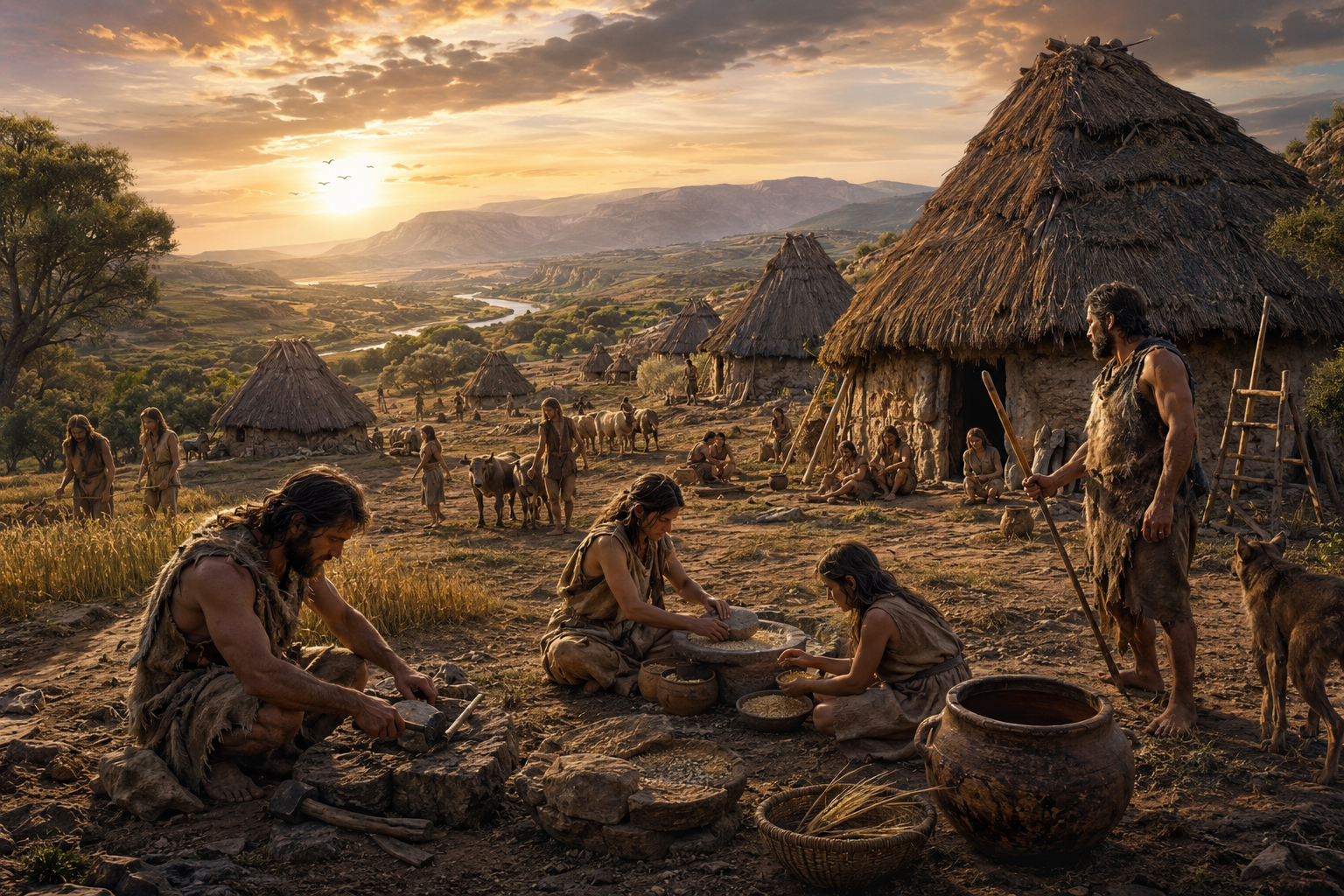
Today, it is almost impossible to imagine human life without electricity, the internet, cars, modern homes, and supermarkets. Yet thousands of years ago, daily life was completely different. People did not simply buy ready-made food. They built their own shelters, relied on what nature provided, and adapted their lives to the changing seasons.
So, what was an ordinary day like for a person living thousands of years ago? Where did they live, what did they eat, how did they dress, and what was family life like?
Archaeological excavations, ancient settlements, human remains, tools, plant seeds, and traces preserved on pottery allow researchers to answer many of these questions.
People Did Not Always Live in Villages
One of the biggest misconceptions about ancient people is the idea that they always lived permanently in the same place.
For thousands of years, many human communities survived through hunting, gathering, and fishing. They moved from one area to another depending on the seasons, animal migrations, and the availability of plants.
However, around 14,000 years ago, longer-lasting settlements began to appear in parts of the Middle East. Archaeological evidence suggests that some people were already staying in the same areas for extended periods even before fully developed agriculture emerged.
This became one of the greatest turning points in human history.
Agriculture Changed Human Life
Around 11,500 years ago, early forms of agriculture began to emerge in parts of the Middle East. Instead of simply collecting wild plants, people increasingly began cultivating certain crops and managing animals.
But this transformation did not happen overnight.
Research suggests that the transition from hunting and gathering to farming was a long and gradual process. Even after agriculture became widespread, some communities continued to rely on fish, wild plants, and other natural resources.
In other words, there was no sudden moment when ancient people simply stopped hunting and became farmers.
Ancient Homes Were More Interesting Than We Imagine
The concept of a home thousands of years ago was very different from what we know today.
People used stone, clay, wood, reeds, and other natural materials to construct shelters. In some settlements, houses were built so closely together that there were almost no conventional streets.
One of the most famous examples is Çatalhöyük, an ancient settlement located in what is now Türkiye.
The houses there were packed tightly together, and some were entered through openings in the roofs. People could move across the rooftops, creating a settlement unlike the cities we know today.
Archaeological evidence from Çatalhöyük includes hearths, storage areas, and other domestic features that reveal important details about everyday life.
What Did Ancient People Eat?
The ancient diet depended heavily on where people lived and which period they belonged to.
The meat of hunted animals, fish, wild plants, fruits, nuts, grains, and later cultivated crops were among the major sources of food.
As agriculture developed, wheat, barley, and various legumes became increasingly important parts of people's diets.
Research conducted at Çatalhöyük has even examined microscopic residues preserved in ancient pottery to determine what kinds of foods people processed and consumed.
Some communities continued fishing and gathering even after they had begun practicing agriculture.
There Were No Refrigerators — So How Did They Store Food?
This was one of the major challenges of ancient life.
For modern people, keeping food in a refrigerator is completely normal. Ancient communities had to rely on other methods.
Archaeological excavations have uncovered storage facilities and structures used to preserve grain and other food supplies. Such facilities allowed communities to build reserves and prepare for periods of seasonal scarcity.
This represented an important development in human society: people were no longer relying only on food obtained that same day. They were beginning to plan for the future.
What Did They Wear?
The clothing of people living thousands of years ago also depended heavily on their environment.
Animal hides were an important material for protection from the elements. Later, people developed the use of plant fibers and increasingly sophisticated forms of textile production.
Archaeological discoveries also suggest that clothing and personal decoration were not simply about protection. Beads, ornaments, and other personal objects indicate that ancient people may have used appearance to express identity and possibly social differences.
Ancient People Were Not Thinking Only About Survival
One of the most misleading images of ancient humans is that they were constantly focused only on finding food and avoiding danger.
Archaeological discoveries tell a more complex story.
Ancient people created art, used symbols, practiced rituals, and developed traditions surrounding death and burial.
At Çatalhöyük, researchers have discovered paintings, animal figures, and other artistic examples on the walls of houses. Burial practices also suggest that people had complex ideas about death and social relationships.
In some houses, the dead were buried beneath the floors.
These discoveries show that thousands of years ago, people were concerned with far more than their immediate physical needs.
What Were Family and Community Life Like?
It is difficult to give a complete and certain answer about the social structure of ancient communities. Because written records did not yet exist in many of these societies, researchers rely mainly on skeletons, houses, burials, and other archaeological evidence.
However, ancient DNA research has opened new possibilities.
A 2025 study analyzed ancient DNA from 131 individuals dating roughly to 7100–5950 BCE at Çatalhöyük. The results suggested that some family and residential relationships were more complex than previously believed.
The study also provides an important reminder: ancient societies did not all follow the same social model.
Nature Shaped Ancient Human Life
Thousands of years ago, people were much more directly connected to environmental changes than modern societies are today.
Drought, cold weather, poor harvests, and changes in animal populations could have affected entire communities.
Research at Çatalhöyük suggests that significant climate changes around 8,200 years ago affected the settlement's inhabitants. Researchers have found evidence that people changed their animal-management strategies, favored animals requiring fewer resources, and adapted aspects of their way of life.
This demonstrates that ancient people were not simply passive victims of environmental change. They also developed strategies to adapt to it.
The Biggest Change: The Meaning of “Home”
Over thousands of years, human life gradually transformed.
Temporary camps evolved into longer-term settlements. Gathering and hunting increasingly gave way to agriculture and animal management. Simple tools developed into more sophisticated technologies.
As a result, villages expanded, populations increased, and increasingly complex social structures emerged.
Settlements such as Çatalhöyük are among the most remarkable examples of this major transition. Archaeological evidence indicates that thousands of people lived there over a long period of time.
So, What Might a Day 10,000 Years Ago Have Looked Like?
Imagine the beginning of an ordinary morning.
People might gather around a hearth, prepare food, collect water and fuel, care for animals, or leave the settlement to hunt, fish, or gather plants.
Part of the day could be spent working in fields, hunting or fishing, while other activities included repairing houses, making tools, preparing food, and protecting stored supplies.
In the evening, family and community members would return and gather together.
But one important point must be emphasized: not all ancient people lived the same way.
A farmer living in the Middle East 10,000 years ago could have had a completely different daily routine from a hunter-gatherer living in Europe or Africa.
That is one of the great strengths of archaeology. Rather than reducing the past to a single story, it allows researchers to reconstruct different human experiences based on evidence.
Conclusion
Life thousands of years ago may appear simple when compared with modern life. Yet archaeological discoveries reveal a much more sophisticated picture.
Ancient people were not simply creatures struggling to survive in the wilderness. They built homes, stored food, managed animals, cultivated plants, created tools, buried their dead, produced art, and organized their communities.
Most importantly, many of the foundations of the modern world — agriculture, permanent settlements, food storage, and increasingly complex societies — were shaped by decisions made thousands of years ago.
In other words, the story of the modern world did not begin with skyscrapers. It began thousands of years ago with the first seeds planted in the soil.
An investigation by FactXəbər.Az