10 Most Extreme Places on Earth: Where Nature Leaves Humans Speechless
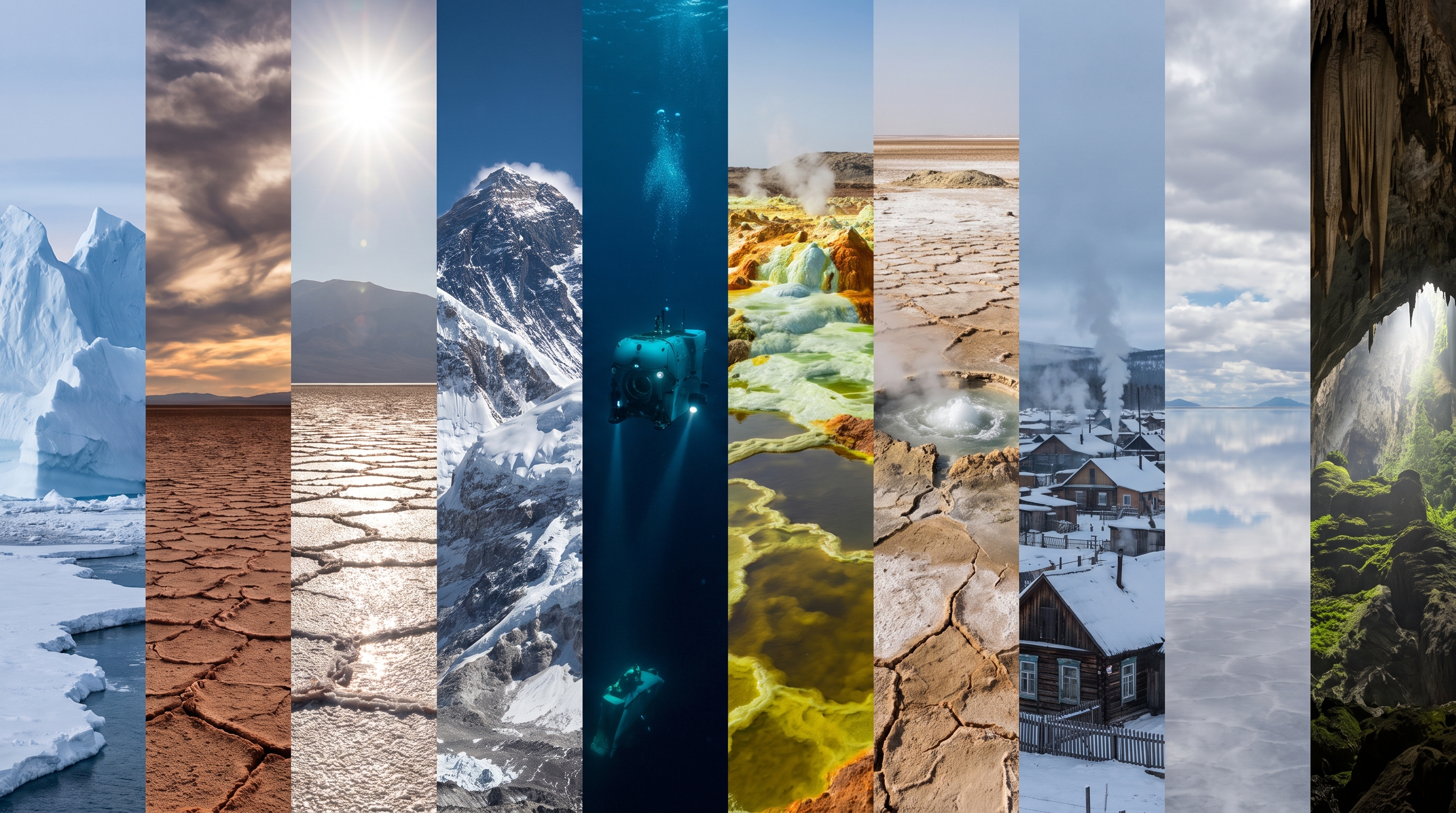
Earth is not only a planet of green forests, blue oceans, and peaceful landscapes. It is also home to places where temperatures, altitude, pressure, dryness, and natural conditions push the limits of human survival.
Some of these places are unbelievably cold. Others are among the hottest and driest locations on Earth. There are also places hidden deep beneath the ocean or underground, where the environment is almost impossible for humans to experience directly.
Here are 10 of the most extreme places on Earth.
1. Antarctica – The Coldest Continent on Earth
Antarctica is the coldest, windiest, and driest continent on our planet. Much of the continent is covered by a massive layer of ice.
The lowest officially recognized air temperature ever recorded on Earth was -89.2°C (-128.6°F) at Vostok Station in 1983.
Despite holding an enormous amount of the world's freshwater in its ice, Antarctica is technically a desert because some areas receive extremely little precipitation.
Its freezing temperatures, powerful winds, and enormous ice fields make Antarctica one of the most extreme environments on Earth.
2. Atacama Desert – One of the Driest Places on Earth
Located in northern Chile, the Atacama Desert is famous for its extreme dryness.
Some parts of the desert can go for years without significant rainfall. The landscape is so dry and unusual that parts of it have been compared to the surface of Mars.
Scientists have studied the Atacama because its harsh, dry conditions provide useful clues for understanding how life might survive in extremely difficult environments.
3. Death Valley – A Land of Extreme Heat
Death Valley in California, USA, is one of the hottest places on Earth.
A temperature of 56.7°C (134°F) was recorded at Furnace Creek in 1913, and it remains one of the highest officially recorded air temperatures in the world.
The valley's extremely low elevation, dry climate, and intense sunlight combine to create brutal summer conditions.
Despite its harsh environment, Death Valley is home to plants and animals that have adapted to survive the heat.
4. Mount Everest – The Highest Point on Earth
Mount Everest rises to approximately 8,849 meters (29,032 feet) above sea level, making it Earth's highest mountain above sea level.
At such extreme altitude, the biggest challenge is not simply the cold. The amount of available oxygen is much lower than at sea level, making physical activity increasingly difficult.
Climbing Everest requires careful preparation, specialized equipment, experience, and an understanding of rapidly changing mountain conditions.
The mountain demonstrates just how far the human body can be pushed by the natural environment.
5. Mariana Trench – The Deepest Place in the Ocean
Deep beneath the Pacific Ocean lies the Mariana Trench, home to the Challenger Deep.
It reaches almost 11 kilometers below sea level, making it the deepest known point in Earth's oceans.
The pressure at these depths is enormous—hundreds of times greater than the pressure at the surface.
Because humans cannot survive there without specially designed equipment, exploration of the deepest ocean depends on advanced submersibles and remotely operated vehicles.
6. Dallol – A Landscape That Looks Almost Alien
Dallol, located in Ethiopia's Danakil Depression, is famous for its extraordinary colors and harsh environment.
The area contains salt formations, hot springs, mineral deposits, and volcanic features. Chemical reactions involving minerals and geothermal activity create bright yellow, orange, green, and white landscapes.
At first glance, Dallol can look like a scene from another planet.
But its unusual appearance is actually the result of complex geological and chemical processes happening right here on Earth.
7. Danakil Depression – One of Earth's Harshest Landscapes
The Danakil Depression in northeastern Ethiopia is known for its extreme heat, volcanic activity, salt flats, and unusual geological formations.
Parts of the region lie below sea level, while temperatures can become extremely high.
The landscape looks almost unreal, with vast salt fields, volcanic features, and mineral-rich pools.
For humans, however, the combination of heat and difficult terrain makes the region an exceptionally challenging environment.
8. Oymyakon – One of the Coldest Permanently Inhabited Places
Oymyakon, located in Russia's Sakha Republic, is widely known as one of the coldest permanently inhabited places on Earth.
Winter temperatures can fall below -50°C (-58°F), while historical measurements have recorded even lower temperatures.
Life in such conditions requires constant adaptation. Starting vehicles, protecting water supplies from freezing, and working outdoors can become serious challenges.
Yet people continue to live and work in this extraordinarily cold environment.
9. Salar de Uyuni – The World's Largest Salt Flat
Located in Bolivia, Salar de Uyuni is the world's largest salt flat, covering roughly 10,000 square kilometers.
During the rainy season, a thin layer of water can cover the surface, transforming the enormous salt plain into a giant natural mirror.
The sky can appear to continue directly beneath your feet, creating one of the most spectacular landscapes on Earth.
This unusual phenomenon has made Salar de Uyuni one of the world's most recognizable natural destinations.
10. Son Doong Cave – A Giant World Beneath the Surface
Hidden in Vietnam, Son Doong is one of the largest known cave passages in the world.
Some sections are so enormous that the cave contains its own underground river, clouds, vegetation, and unique ecosystems.
Instead of extreme cold, heat, or altitude, Son Doong demonstrates another kind of natural extremity: enormous spaces hidden beneath the Earth's surface.
Exploring the cave feels less like entering a normal cave and more like discovering an entirely different world.
Nature Beyond Human Limits
From the frozen landscapes of Antarctica to the crushing depths of the Mariana Trench, these places reveal just how diverse our planet really is.
Extreme environments remind us that Earth is far more than the familiar landscapes we see every day. Somewhere on the planet, there is always a place where temperature, pressure, altitude, dryness, or geology reaches an extraordinary level.
And perhaps the most fascinating fact is that all of these extreme environments exist on the same planet we call home.