What Would Happen If Earth Suddenly Stopped Spinning?
What Would Happen If Earth Suddenly Stopped Spinning?
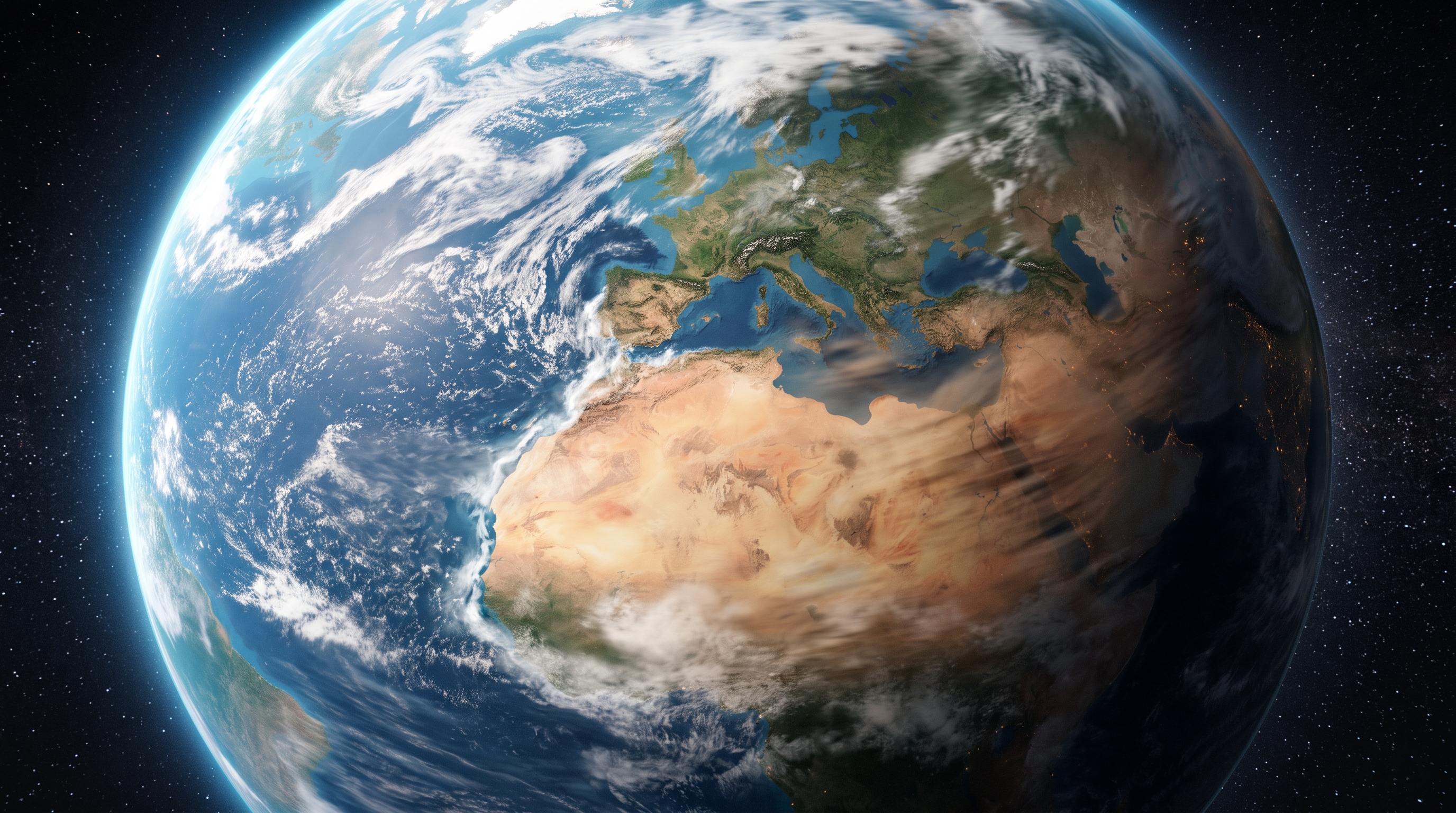
Earth is constantly rotating at enormous speed, even though we cannot feel it. But what would happen if our planet suddenly stopped spinning? The consequences would be far more dramatic than most people imagine.
Earth completes one rotation on its axis in roughly 24 hours. Everything on the planet—including people, oceans, buildings and the atmosphere—moves along with it.
Now imagine that this rotation suddenly came to a complete stop.
The consequences would begin almost immediately.
What Would Happen in the First Seconds?
If Earth suddenly stopped rotating, people and objects on its surface would not instantly stop moving.
The reason is inertia.
Near the equator, Earth's surface is moving at roughly 1,670 kilometers per hour (about 1,040 miles per hour) because of the planet's rotation.
If the ground suddenly stopped while everything else retained its motion, the atmosphere, oceans and objects on the surface would continue moving relative to the ground.
This would create extraordinarily powerful winds and destructive forces across the planet.
Buildings, trees, vehicles and other structures would be exposed to extreme conditions.
The Oceans Would Be Dramatically Affected
Earth's rotation plays an important role in the movement and distribution of the atmosphere and oceans.
If the planet suddenly stopped rotating, enormous amounts of water would continue moving because of inertia. Coastal regions could face catastrophic flooding and massive waves.
However, the exact outcome would depend on how Earth stopped.
If Earth stopped rotating but continued orbiting the Sun, the consequences would be different from a scenario in which both Earth's rotation and its orbit around the Sun somehow stopped.
Days and Nights Would Become Extremely Long
If Earth stopped rotating on its axis but continued moving around the Sun, the familiar 24-hour day-night cycle would disappear.
Instead, the Sun's apparent position in the sky would change much more slowly.
Many parts of the planet could experience extremely long periods of daylight followed by extremely long periods of darkness.
This would have enormous consequences for temperatures.
Areas exposed to sunlight for prolonged periods would become much hotter, while regions experiencing extended darkness could become dramatically colder.
Weather and Climate Would Change
Earth's rotation influences atmospheric circulation and large-scale wind patterns.
Without rotation, the global climate system would be radically different.
The familiar patterns of winds, storms and atmospheric circulation would change, affecting ecosystems around the world.
Agriculture, water resources and the habitats of countless species could also be affected by these environmental changes.
Why Does Earth Rotate in the First Place?
Earth's rotation dates back to the formation of the Solar System.
Billions of years ago, the material that eventually formed the Sun and planets existed as a vast rotating cloud of gas and dust.
As this material collapsed and formed planets, the conservation of angular momentum helped maintain their rotation.
Earth has continued rotating ever since.
Its rotation is not perfectly constant. Very small changes occur over time, influenced by factors including interactions between Earth and the Moon.
What If Earth Stopped Slowly Instead?
A gradual slowdown would be very different from an instant stop.
If Earth's rotation slowed over an extremely long period, ecosystems and living organisms would have more time to adapt to changing conditions.
The length of days would gradually increase, while atmospheric and oceanic systems would slowly respond to the changing rotation.
That scenario would be dramatically different from the immediate destruction caused by a sudden stop.
Why Is Earth's Rotation So Important?
Earth's rotation is much more than an astronomical curiosity.
It influences the day-night cycle, atmospheric circulation, ocean behavior and global climate systems.
The movement is so constant that humans rarely notice it, yet it is one of the fundamental characteristics of our planet.
Every moment we spend standing still on Earth, we are actually traveling through space on a rotating planet.
The Bottom Line
If Earth suddenly stopped spinning, the consequences would be global and potentially catastrophic.
Because of inertia, the atmosphere, oceans and objects on Earth's surface would continue moving, creating extreme winds, enormous waves and widespread destruction.
Climate and weather systems would also eventually be transformed.
The remarkable part is that we normally feel none of this motion.
We may appear to be standing still, but beneath our feet is a planet rotating through space at an extraordinary speed.