Scientists Discover a Mysterious 1,600-Kilometer Cloud on Mars That Defies Explanation
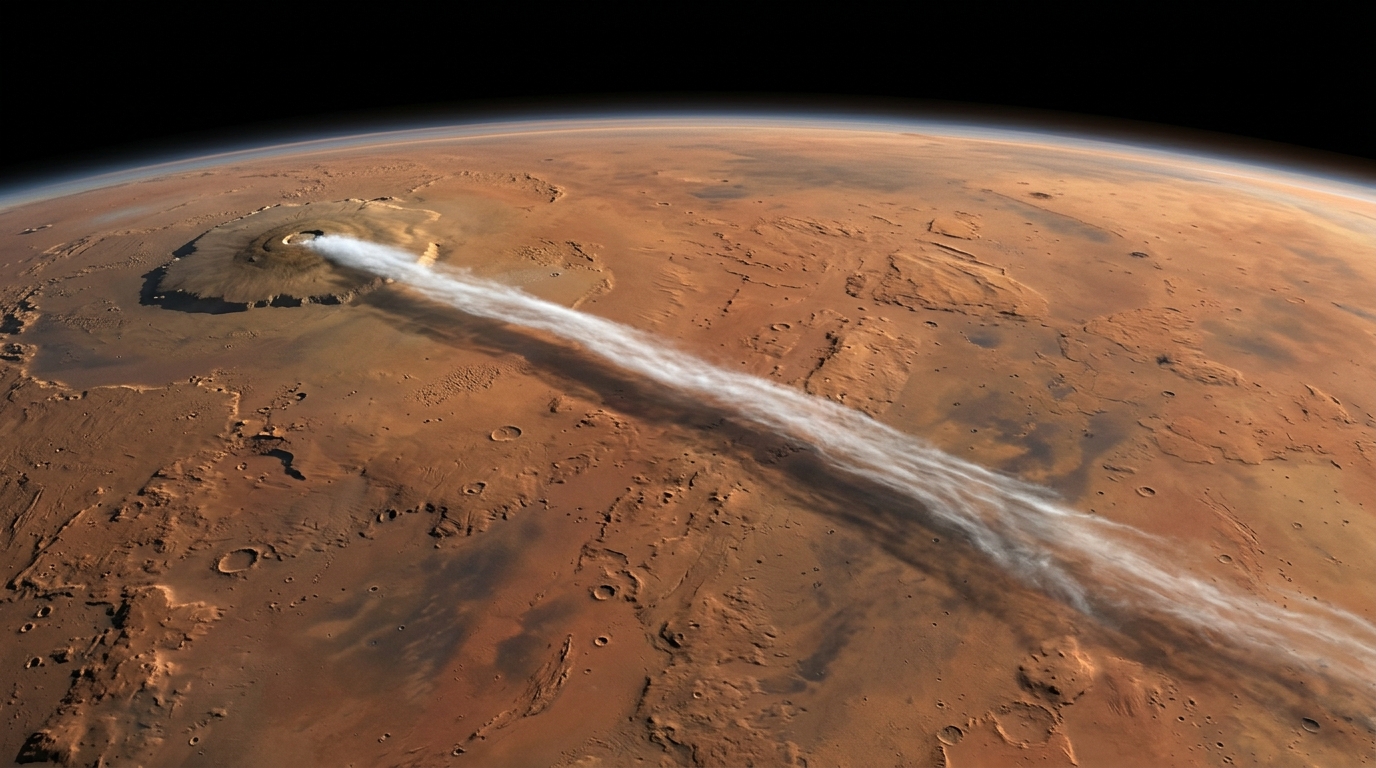
A cloud that appears over Mars every day and then disappears, stretching approximately 1,600 kilometers (about 994 miles), may be even more unusual than scientists previously believed.
Known as the Arsia Mons Elongated Cloud (AMEC), the phenomenon may require scientists to consider physical processes that have never been observed in Earth's atmosphere or elsewhere in the Solar System.
According to the Hungarian publication 24.hu, the latest modeling results have shed new light on this extraordinary Martian phenomenon.
The AMEC frequently forms above Arsia Mons, an extinct volcano approximately 20 kilometers high in the Tharsis region, south of Mars's equator. The water-ice cloud was first recorded in 2018 by the European Space Agency's Mars Express spacecraft.
Since then, the cloud has been observed almost every morning during the Martian spring and summer, when increasing solar radiation helps generate strong winds near the planet's surface. However, it remains visible for only a few hours before disappearing.
Although dust clouds are common on Mars, the planet's atmosphere contains very little water vapor. This makes the formation of clouds resembling those on Earth relatively unusual. Their enormous size raises further questions for researchers.
Scientists have therefore spent years trying to understand how this remarkable atmospheric phenomenon develops. In a new study, researchers used observations from Mars Express to build models that could explain the cloud's formation.
What Have Scientists Discovered?
Initially, researchers struggled to reproduce the mysterious phenomenon using conventional atmospheric models. They eventually developed an explanation by considering processes that are difficult to observe directly under familiar atmospheric conditions.
Scientists believe the AMEC is an orographic cloud, a type of cloud that forms when strong winds push moist air upward along the slopes of a mountain or volcano.
Similar clouds occur on Earth. One example is the Levante cloud, which sometimes forms above the Rock of Gibraltar in southern Europe.
However, researchers suggest that the Martian phenomenon cannot be explained entirely by applying the same atmospheric processes observed on Earth.
During the formation of AMEC, water vapor appears to turn directly into ice crystals without the usual condensation particles that help initiate the process. Scientists describe this phenomenon as homogeneous nucleation.
According to the report, the researchers believe this process has not previously been observed in a planetary atmosphere.
Another major question concerns the source of the large amount of water needed to create such an enormous cloud.
Scientists suggest that some of the water vapor may already be present in the Martian atmosphere, while the remainder could come from frost covering the summit of Arsia Mons.
The exact contribution of these potential sources remains an important subject for further investigation.
Why Is the Mars Express Spacecraft So Important?
Researchers emphasize that the discovery and continued observation of AMEC would have been much more difficult without the European Space Agency's Mars Express mission.
The spacecraft first detected the cloud in 2018 and has continued observing it over the years, providing valuable information about its appearance, development, and possible origins.
These observations have helped scientists develop new models and investigate one of Mars's most intriguing atmospheric mysteries.
Although important questions remain unanswered, studying AMEC could improve our understanding of how water behaves in the Martian atmosphere and how weather systems develop on other planets.
The discovery also highlights how long-term spacecraft observations can reveal unexpected processes on worlds that are very different from our own.
As researchers continue investigating the giant cloud, Mars may yet offer further clues about the unusual physics governing its atmosphere.