The Future Is Already Here: 10 Technologies Changing Everyday Life
The Future Is Already Here: 10 Technologies That Will Change Everyday Life
The future didn't arrive with flying cars. It arrived quietly — inside our phones, homes, cars, glasses and even our brains.
For decades, futuristic technology seemed like something that belonged to science-fiction movies. Robots walking among humans, computers understanding natural language, cars driving themselves and machines responding to our thoughts all sounded impossible.
Today, many of these ideas are becoming real.
Some technologies are already available to consumers, while others are still being developed in laboratories and research centers. But together, they reveal something fascinating: the way we live, work and communicate could change dramatically during the next decade.
Let's explore 10 technologies that could become an ordinary part of everyday life.
1. AI Agents: AI That Doesn't Just Answer — It Acts 🤖
Most people already know AI assistants that can answer questions, write text or create images.
The next step is AI agents.
Instead of simply responding to a request, an AI agent can potentially perform a series of tasks on a user's behalf.
Imagine saying:
“Plan my weekend trip.”
An AI agent could search for transportation, compare hotels, organize a schedule and prepare the information for you.
Why does it matter?
Today, we interact with dozens of apps. In the future, we may increasingly interact with one intelligent system that works across many services.
💡 Did You Know?
The major shift is not simply smarter chatbots. It is the movement from AI that generates answers toward AI systems designed to complete tasks.
🔮 What happens next?
AI agents could become digital assistants for shopping, travel, education, work and personal organization.
2. Brain-Computer Interfaces: When Thoughts Meet Technology 🧠
What if you could control a computer without touching a keyboard or screen?
That is the idea behind brain-computer interfaces (BCIs).
These systems attempt to detect signals from the brain and translate them into commands that a computer can understand.
Researchers are exploring applications that could help people with severe physical disabilities communicate or interact with digital devices.
The technology is still developing, but the concept is extraordinary.
Imagine the future
You think about moving a cursor.
The computer detects the relevant brain signal.
The cursor moves.
No mouse. No keyboard.
⚡ Future Possibility:
BCIs could eventually create new ways of interacting with computers, although major technical, medical, ethical and privacy challenges remain.
3. AI Smart Glasses: The Internet in Your Field of Vision 👓
Smart glasses have existed for years, but artificial intelligence could make them much more useful.
Future AI-powered glasses could potentially recognize objects, understand conversations, translate languages, provide navigation information and answer questions about what the wearer sees.
Imagine walking through a foreign city.
You look at a building.
Your glasses identify it and provide information.
You see a restaurant menu.
The system translates it.
You hear someone speaking another language.
AI provides assistance.
The big change
Instead of constantly looking down at a smartphone, information could increasingly appear through voice and visual interfaces.
💡 Did You Know?
This represents a broader technological trend: computing is gradually moving beyond traditional screens.
4. Self-Driving Cars: From Driver to Passenger 🚗
Cars have already become computers on wheels.
Modern vehicles can use cameras, radar, sensors and software to assist drivers with braking, parking, lane keeping and navigation.
The next stage is greater automation.
A truly autonomous vehicle would be capable of handling driving tasks without continuous human control under defined conditions.
What could change?
Imagine getting into a vehicle and simply saying:
“Take me home.”
The vehicle handles the journey.
This could affect transportation, delivery services, urban planning and accessibility.
However, autonomous driving still faces technological, regulatory, infrastructure and safety challenges.
5. AI-Powered Smart Homes 🏠
Smart homes are already capable of controlling lights, thermostats, cameras and appliances.
But future homes could become much more intelligent.
Instead of waiting for commands, an AI-powered home could learn patterns and respond automatically.
For example:
Morning: The house adjusts temperature and lighting.
Evening: It reduces unnecessary lighting and prepares the environment for relaxation.
Away: Security systems monitor the property.
The goal is not simply to connect devices.
It is to create a home that can understand context and respond intelligently.
🔮 The future home
Your home could become less like a collection of smart devices and more like one connected digital environment.
6. Humanoid Robots: Machines That Move Like Us 🦾
Humanoid robots are one of the most visually striking developments in modern technology.
Why make a robot look like a human?
One reason is simple: our world is designed for human bodies.
Doors, stairs, tools, kitchens and factories are built around human movement.
A robot with a human-like shape could potentially operate in environments that already exist without requiring everything to be redesigned.
Where could they work?
Manufacturing
Warehouses
Logistics
Dangerous environments
Elderly assistance
Household tasks
The technology is still developing, and widespread everyday use is not guaranteed.
But the possibility is becoming increasingly realistic.
💡 Think About It:
If a robot could safely perform repetitive physical tasks, how might that change the way humans spend their time?
7. The Battery Revolution 🔋
Many futuristic technologies depend on one surprisingly simple thing:
Better batteries.
Electric cars, robots, smartphones, drones and renewable-energy systems all require efficient energy storage.
Researchers are exploring new battery chemistries and designs that could potentially improve energy density, charging speed, lifespan and safety.
Why is this important?
A better battery could mean:
🔋 Longer-lasting devices
⚡ Faster charging
🚗 Greater electric-vehicle range
🏠 Better energy storage
🤖 More capable robots
Sometimes the most important technological revolution isn't the device itself.
It's the technology powering it.
8. AI and Personalized Medicine 🧬
Medicine is also entering an increasingly data-driven era.
Artificial intelligence can analyze large amounts of medical information and researchers are investigating ways it can assist with areas such as medical imaging, drug discovery and personalized treatment.
In the future, healthcare could become increasingly tailored to individual patients.
Instead of relying only on broad treatment approaches, doctors may have access to more detailed information about a person's genetics, medical history, lifestyle and other relevant data.
⚠️ Important
AI does not replace doctors simply because it can analyze information quickly.
Healthcare involves complex human decisions, clinical evidence, ethics and responsibility.
The most realistic future is likely to involve humans and AI working together.
9. Spatial Computing and Augmented Reality 🥽
Imagine putting on lightweight glasses and seeing digital information integrated into the physical world.
That is the promise of augmented reality and spatial computing.
Instead of opening an app on a flat screen, digital objects could appear around you.
A student could see a three-dimensional model of the human heart.
An engineer could examine a virtual machine component.
A tourist could receive directions overlaid onto a real street.
From screens to spaces
This could represent another major shift in computing:
From looking at information → to interacting with information around us.
10. Quantum Computing: A Completely Different Kind of Computer ⚛️
Traditional computers process information using bits.
Quantum computers use quantum-mechanical principles to process information in fundamentally different ways.
They are not simply “faster computers” for everything.
Instead, researchers are exploring whether quantum systems could provide advantages for certain highly complex problems.
Potential areas of interest include:
Materials science
Chemistry
Optimization
Cryptography
Scientific research
Quantum computing remains an emerging field, and practical large-scale applications are still being developed.
But if the technology reaches its potential, it could open computational possibilities that are difficult to achieve with conventional machines.
🚀 The Bigger Picture: What Connects All 10 Technologies?
At first glance, these technologies seem unrelated.
Robots.
AI.
Batteries.
Brain interfaces.
Smart glasses.
Quantum computers.
But there is a common thread.
They are all moving computing closer to the physical world.
For decades, we interacted with computers through keyboards, mice and screens.
Now computers are beginning to:
See.
Hear.
Move.
Understand language.
Analyze environments.
Interact with physical objects.
Assist humans in real-world tasks.
That may be the most important technological shift of all.
🧠 Quick Technology Quiz
Which technology could allow a person to interact with a computer using brain signals?
A) Quantum computing
B) Brain-computer interface
C) Smart thermostat
D) Solid-state display
Answer: B — Brain-computer interface.
🔍 Myth or Fact?
“Humanoid robots will immediately replace human workers.”
Myth — at least for now.
Humanoid robotics is developing rapidly, but replacing human labor on a large scale involves much more than building a robot that can walk.
Cost, reliability, safety, regulation, maintenance and the ability to perform complex tasks all matter.
The future impact will depend on how these technologies develop and how businesses and societies adopt them.
🌎 How Will These Technologies Change Everyday Life?
The most important changes may not look dramatic.
You might not wake up one morning to find robots everywhere.
Instead, change could happen gradually.
Your AI assistant handles more tasks.
Your glasses provide information when you need it.
Your car takes over more of the driving.
Your home automatically manages energy.
Your doctor uses AI-assisted tools.
Your computer becomes less dependent on a traditional screen.
One technology at a time, the future becomes normal.
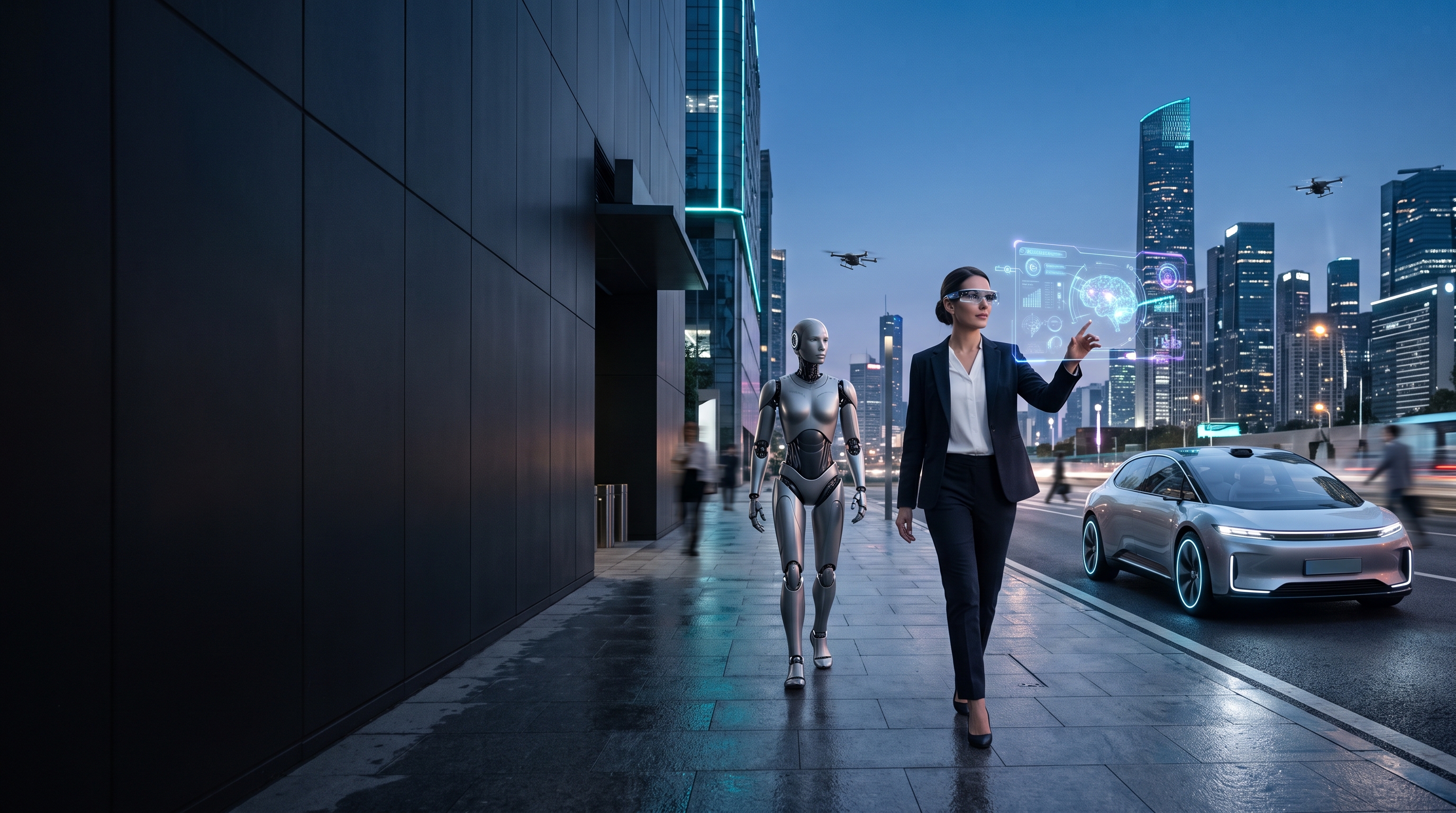
🔮 What Could Everyday Life Look Like in 2035?
Imagine waking up.
Your home has already adjusted the temperature.
Your AI assistant summarizes the day's schedule.
Smart glasses provide directions as you leave.
An autonomous vehicle takes you to work.
At work, AI agents handle routine digital tasks while humanoid robots perform certain physical jobs.
Later, your healthcare system uses personalized data to help monitor your health.
None of this guarantees a particular future. Technology can develop in unexpected directions, and social, economic, legal and ethical decisions will shape which innovations become widespread.
But one thing is clear:
The future of technology is no longer something that exists only in science fiction.
It is being built today.
💡 Final Thought
The most fascinating question isn't:
“What will technology look like in the future?”
It is:
“Which technologies that seem extraordinary today will feel completely ordinary tomorrow?”
The answer may be closer than we think.
Frequently Asked Questions
What is the most important future technology?
There is no single technology that determines the future. AI, robotics, advanced batteries, spatial computing, biotechnology, autonomous systems and quantum computing are developing along different paths and could affect different parts of society.
Will AI change everyday life?
AI is already being integrated into search, communication, creative tools, software, customer service and other areas. Future AI systems may become increasingly capable of performing multi-step tasks.
Will humanoid robots become common?
Humanoid robots are under active development, particularly for industrial and logistical applications. Their eventual widespread adoption will depend on capability, cost, safety and other practical factors.
Will smartphones disappear?
Not necessarily. New interfaces such as smart glasses, voice assistants and spatial computing could change how people use smartphones, but it is uncertain which devices will become dominant.
When will these technologies become mainstream?
There is no single timeline. Some are already commercially available, while others remain experimental or are still being developed.
📌 Related Topics
Artificial Intelligence • Future Technology • Robotics • Smart Homes • Electric Vehicles • Brain-Computer Interfaces • Quantum Computing • Augmented Reality • Emerging Technologies • Technology Trends